Welcome to the world of Timeboxing! No, you are not going to box against time, but you are going to box against procrastination, stagnation, and anxiety.
01What Is Timeboxing?
Timeboxing can be thought of as an agile methodology where you allocate a set amount of time for each activity, task, or project. This set amount of time is called a timebox.
The goal is to focus on the activity the time is blocked for, and when the block ends, you move on to the next activity.
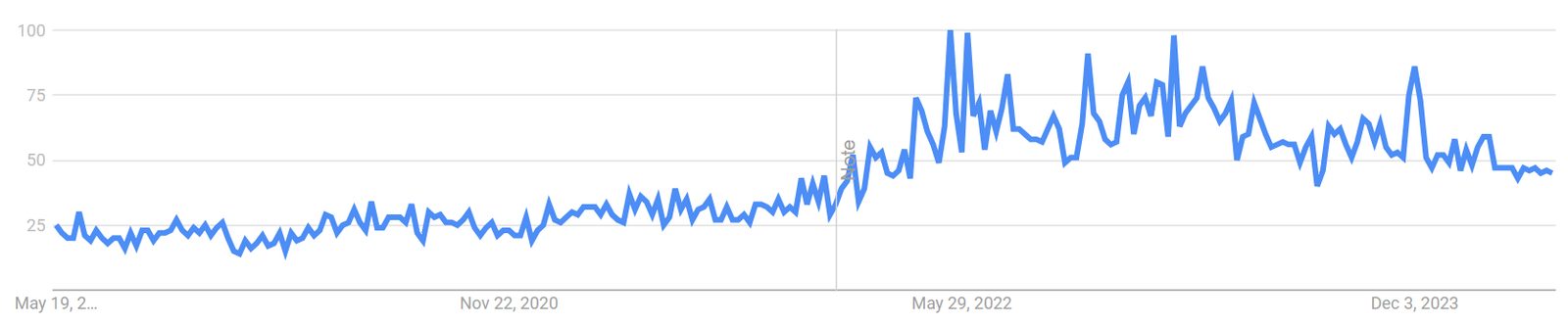
Timeboxing has increased in popularity thanks to the fact that many productivity authors, motivational gurus, CEOs, and high performers have spoken about it at length, and some even attribute their success to it.
Elon Musk, Bill Gates, Marc Zao-Sanders, Nir Eyal, and Warren Buffett are prime examples of highly successful people who recommend timeboxing for productivity and personal management.
And if it works for them, it can work for you too.
02Is Timeboxing for Everybody?
Timeboxing is a strategy that will work for anyone who implements it the right way.
If you’re naturally organized, you may struggle to see the immediate benefits, but over time, its compounding effect will have you worshiping it as a gift from the universe and rethinking how you organize your day.
On the other hand, timeboxing works best for people who fit into any of the following categories (not an exhaustive list)
- ADHD
- Task anxiety
- Result-driven
- Lack of motivation
- Excessive workloads
- Emotional dysregulation
- Bad or no routines/habits
03The Two Biggest Benefits of Timeboxing
“Compound interest is the eighth wonder of the world. He who understands it, earns it … he who doesn’t … pays it.”
Timeboxing is all about compounding progress. You move the needle a tiny bit each day, and before you know it, you’ve made more progress than you would have otherwise.
But the benefits extend far beyond just accomplishing and achieving.
Most of us have dealt with procrastination and a lack of motivation to get things going. These negatives aren’t innate, they’re byproducts of circumstances and environment.
Procrastination is a byproduct of fear and a lack of motivation. Lack of motivation is a byproduct of a lack of discipline. The root cause is a lack of discipline. Everything else good flows directly from discipline.

Timeboxing excels at building discipline. In fact, it’s far better at building discipline than any other strategy you’ll encounter. Cold showers, 5 a.m. alarms, morning jogs, and meditation all fall flat if you can’t stick to them. The only way to stick to them is to timebox them.
Why?
Because our brains are hardwired to seek out and create routines. Once a routine sets in, we switch to autopilot. If you’ve done the thing at 2 p.m. for 50 days in a row, then on day 51 you’ll find yourself doing it again, no matter how you feel.
You’re functioning with pure discipline.
And that moves mountains!
04How to implement Timeboxing the Right Way
There are many ways to timebox your day. Some people like to timebox their whole day, while others block out only certain portions. Either works, depending on what you want to accomplish.
But the best way to do it is to timebox your whole day into 10-week stretches.
Why?
Because, on average, that’s how long it takes your brain to build the discipline you need to keep going when motivation is absent.
Steps to Build Your Day:
- Pick Monday to Friday as your timebox days.
- Create a schedule for each day and set it to repeat for the next nine weeks.
- Look at every hour and assign it something.
- Be realistic: no less than 30 minutes and no more than 1.5 hours per timebox.
- Include bedtime, wake-up time, and periodic breaks as timeboxes. Don’t skip breaks.
- Add variety between tasks. Don’t keep difficult ones adjacent, spread them apart.
- Use weekends to refine your week, but avoid drastic changes.
- Stick to it no matter what for the first two weeks, and watch the magic happen in the third.
Below is a working example of a timebox that I am using right now.
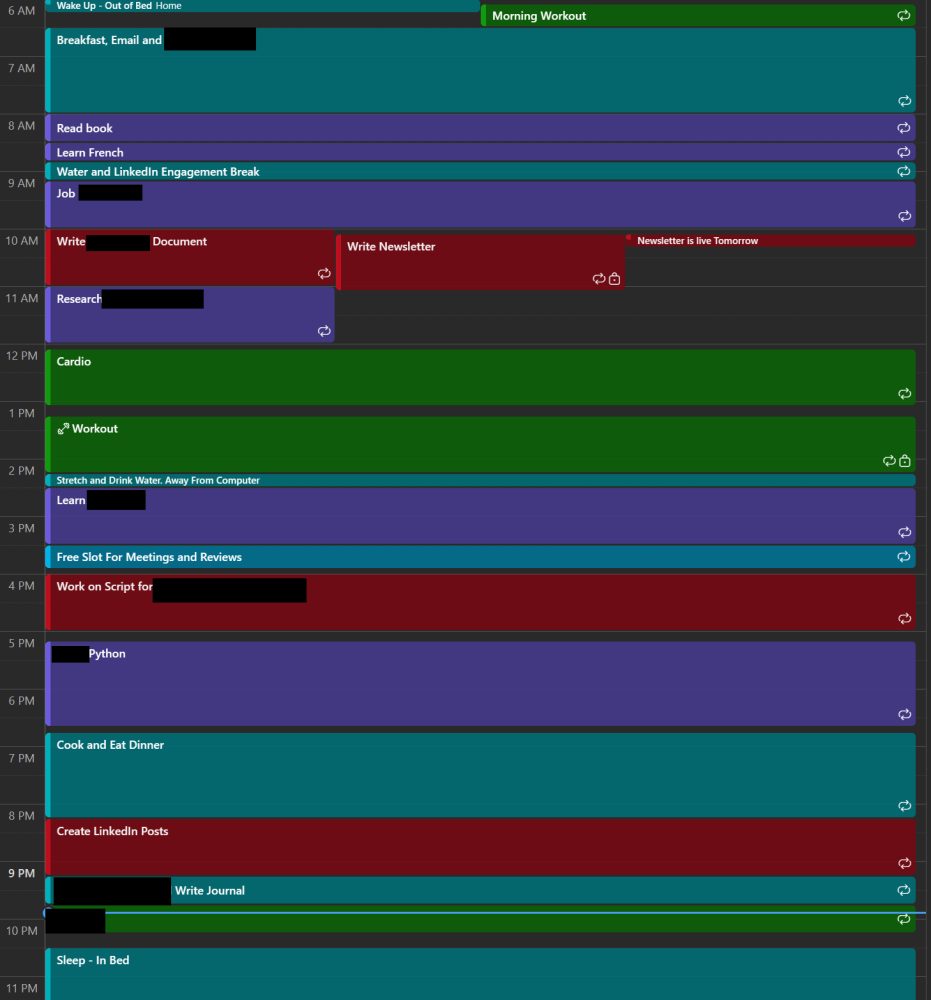
The color codes represent the type of task and if it repeats every day. The purple ones update weekly and the red ones last a full month. The rest is permanent for 10 weeks.
If I am meeting with a client then I assign them one of the purple timeboxes depending on my availability and if I am working on their project then I assign the researching and Job boxes to myself to make progress on those tasks.
This way I am always moving forward no matter what happens in my day. The green boxes are meant to keep me active and moving so I dont become an office chair Koala.
Nine times out of ten, I dont even have to look at the boxes to know what I am doing. The routine kicks in automatically and my mental state shifts into a different mode.
On the weekends I make changes to the purple boxes depending on what the following week has in store for me.
Notice there are gaps between tasks that have not been assigned anything. These are overflows to help with completion if needed. Otherwise, they are perfect for taking a short break doing whatever I like before moving onto the next block.
If the image above is intimidating then definitely get to work implementing something similar.
Don’t give it a seconds thought.
05Personal Reflections on Timeboxing
Organizing myself this way, I’ve noticed I do a much better job managing my emotions, motivation, and desire for results.
Not every block produces output. Some are purely input-based, which can frustrate the monkey brain. But variety ensures periodic rewards, so I don’t give up on the system.
Using this approach, I have:
- Achieved certifications in Python, Django, Machine Learning, Artificial Intelligence, Finance, and Investing
- Created a LinkedIn content strategy that doubled my follower base
- Started a growing newsletter
- Learned to read and speak French
- Worked with clients from four countries
- Helped YouTube, TikTok, and Instagram creators refine content and build consistency
- Improved my video editing skills
- Maintained a consistent sleep schedule for the first time in my life
Of course, challenges arise. But the system allows for deviation and has built-in compensation.
When I’m distracted or exhausted, I commit to at least the last 10 minutes of the block. Even if it’s just one line of writing or editing a minute of video, I still do it.
Why?
Because compounding.
Don’t measure the output, measure the input.
Was there input, and were you focused for at least 10 minutes?
If yes, then you’re golden. Move on. Let the work compound.
If you are still hesitant, then trial the system for five weeks and see how it makes you feel. I cannot guarantee the sun and moon with this system, but what I can promise you is that you will feel like a completely different person with no desire to go back to your old ways.
Remember to leave the weekends completely free and unstructured.
Your brain will thank you.